
TL;DR
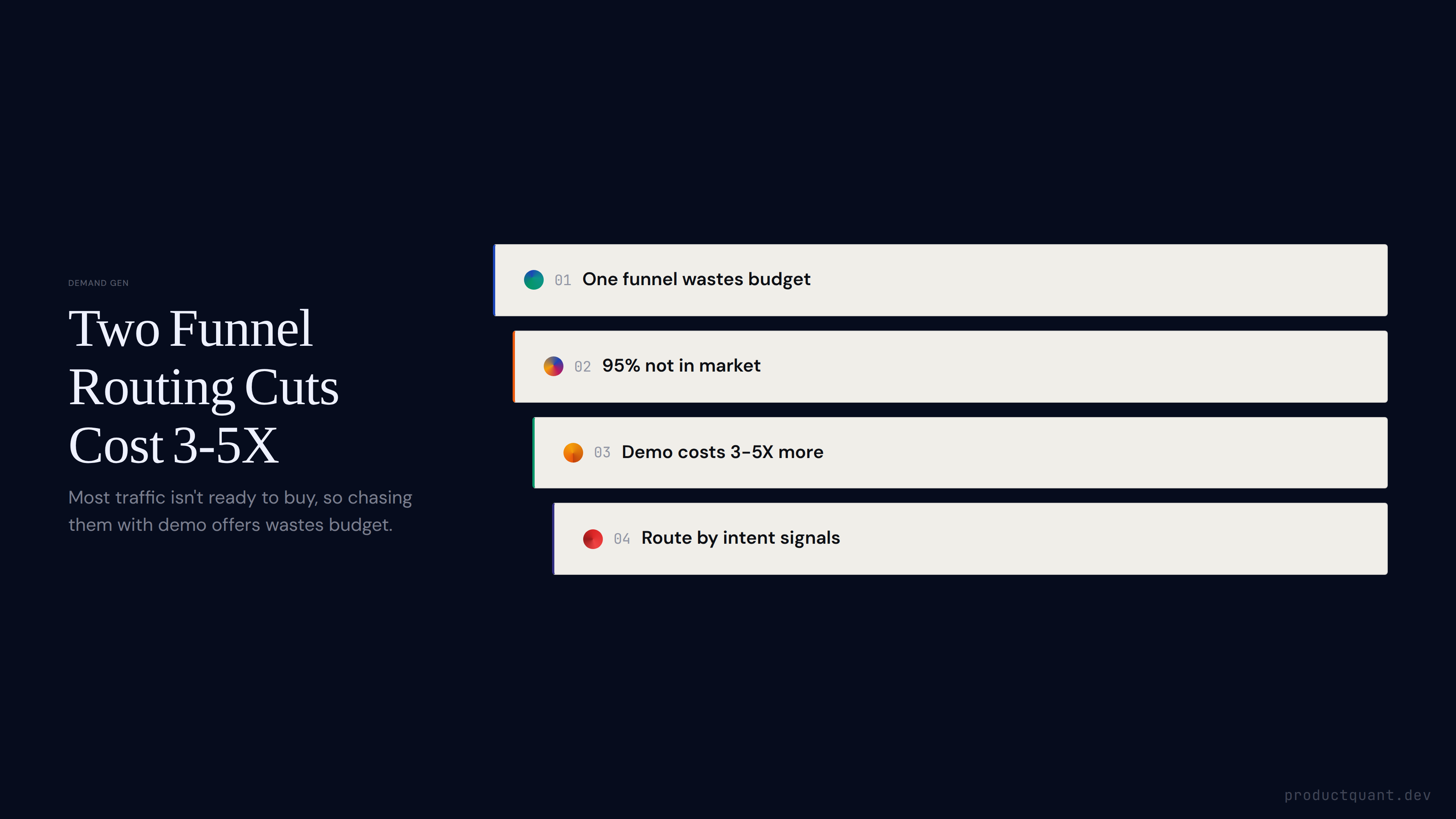
- Fast path for the ready. Problem. aware buyers convert now. Route them to a booking flow, not a nurture track.
- Warm path for the rest. 95%. of your category is not in market. Educate them with low friction content until intent signals appear.
- 3 to 5 times cost gap.. A demo request costs 3 to 5 times more than a content download on the same channel. Blended cost is the metric that matters.
- The beachhead decides. A documented routing. rule based on source and behavior points each visitor to the right funnel.
One Funnel Leaks Budget
Most teams build one funnel and pour all traffic into it. That funnel is shaped by the average visitor, which means it serves no one well. Eugene Schwartz mapped this in 1966: five awareness stages, from Most Aware down to Unaware. Modern traffic temperature is a simplified version of that framework.
The operator version is simple. Some visitors are combing for a solution and will book a call right now. Others are still defining the problem and would bounce at the first demo ask. Rob Palmer, writing on Schwartz in 2026, puts a fine point on it: if your funnel treats all cold traffic the same, you are leaving significant conversion on the table.
The cost of that mistake shows up in the benchmarks. Stackmatix places a demo request at $150 to $300 per lead on LinkedIn. A content download runs $50 to $100. You are paying 3 times more for the people who are not going to buy yet, and you are paying the same acquisition price for the 5% who would have converted anyway.
of B2B marketers expect campaign effect within two weeks. Meanwhile 95% of the category is not in market. The expectation is misaligned with the reality, and the one funnel is where that misalignment turns into wasted spend.
When you route everyone to one path, you fund the unready at the same cost as the ready. That is the leak. The fix is not a bigger funnel. It is a second one.
Two Funnels, One Beachhead
The fix is two funnels shaped by awareness stage. The fast path is for Problem Aware and Solution Aware buyers. They know the problem, they are evaluating options, and they will take a meeting. Give them a booking flow, a calendar link, or a direct demo CTA. The goal is speed, not education.
The warm path is for the Unaware and lightly aware crowd. They do not know they have the problem yet, or they are not looking. Give them content downloads, benchmark reports, webinars. Low friction, no hard sell. Revnew describes it as the marketing waiting room versus the sales waiting room. Walk into each with the same pitch and you will lose both.
Offer type matters as much as channel. The LinkedIn ladder from Stackmatix is a good template: benchmark reports and whitepapers for the warm path, webinars for the middle, demo requests for the hot end. Matching the offer to the stage is what makes each funnel efficient.
The two funnels need different offers, different cadence, and different goals. Fast path optimizes for meetings booked this week. Warm path optimizes for a rising score that will trigger a meeting later.
The Beachhead Routing Rule
The beachhead is the routing rule. It decides which funnel each visitor enters based on the signals you already have. Traffic source is the first signal. Hot search and retargeting map to Product Aware or Most Aware. Cold social and display map to Problem Aware or Unaware.
Behavior is the second signal. A visitor who downloaded a benchmark report is further along than one who bounced off a static page. Intent signals change the math. Digital Applied reports intent sourced leads close at 18.7% versus 5.5% for cold ICP match, with 23% higher average contract value. Those are the buyers you route to the fast path.
Do not make the beachhead a guess. Write down the source to funnel mapping and the behavior triggers that move someone from warm to fast. The teams that do this see the payoff. 42 Agency found that teams with a documented ICP and lead scoring see 40% to 60% lower CPL than broad targeting.
The beachhead is not a gate. It is a filter. You are not stopping anyone. You are pointing each visitor down the correct track before you spend another dollar on them.
The Cost Math Is Brutal
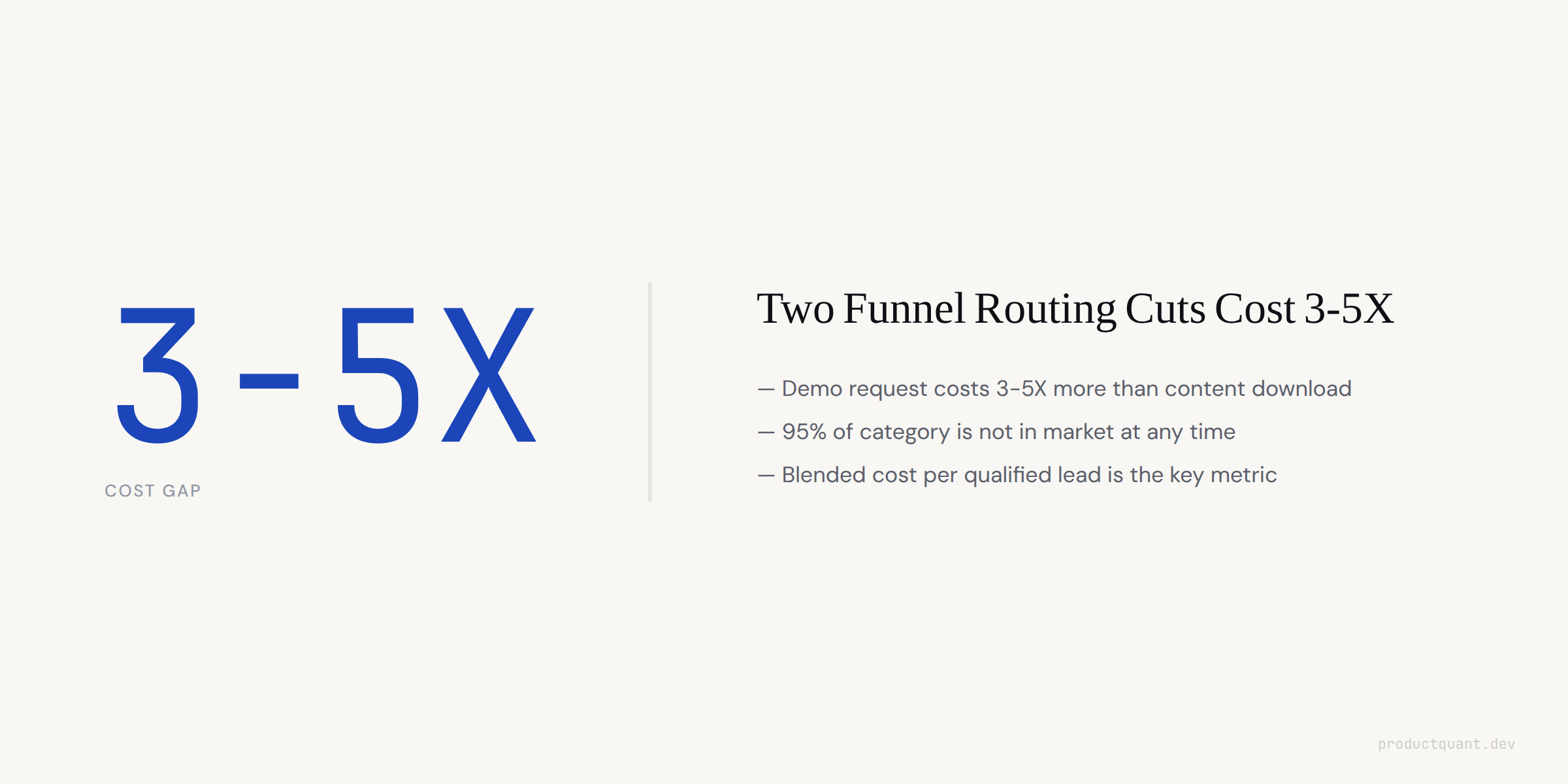
Here is the part that hurts. A demo request on the same channel as a content download costs 3 to 5 times more. Stackmatix puts the LinkedIn CPL ladder at $50 to $100 for a content download, $75 to $150 for a webinar, $150 to $300 for a demo request. The 3 to 5 times gap holds across 42 Agency's 87 SaaS clients as well.
Stackmatix says it plainly: a campaign offering a free industry benchmark report to VPs of Marketing will produce a CPL 3 to 5 times lower than a campaign asking the same audience to request a demo.
That does not mean the demo is a bad offer. It means the demo offer is the wrong offer for the 95% who are not in market. You are paying premium prices to acquire people who need months of nurturing before they are ready to talk.
Structuring a LinkedIn strategy as a two step process, low friction offer for initial capture, then nurture toward demo, almost always produces a lower blended cost per demo qualified lead than asking for demos directly.
That is the economic argument for the warm path. You pay less to capture, then you pay to advance only the ones who show intent. The blended number is what matters, not the raw CPL.
Why the 80 Percent Matter
The warm path exists because the market is almost entirely not ready. The LinkedIn B2B Institute and Ehrenberg Bass found that only about 5% of a category is in market at any given time. 95% are not looking, and they will not convert on a demo ask no matter how good your landing page is.
The 80/20 rule shows why that 95% still matters. The B2B Playbook states the demand gen version clearly: 20% of your customers generate 80% of your revenue. Cirrus Insight adds that 50 solid leads beat 500 tire kickers. The warm path is how you keep the future 20% moving without paying today's demo prices for them.
The 95% are not static. They are between purchases. Gartner notes that 61% of B2B buyers prefer a rep free buying experience, which means they will do their own research before they ever raise a hand. The warm path is where that research happens.
of the category is in market at any time. The other 95% are the source of future cash flows. Ignore them and you will keep resetting the funnel.
Warm leads also respond better when they do engage. Reach Marketing reports cold response rates of 1% to 5% versus 10% to 30% for warm. The same offer works better when the timing is right, and the warm path is how you control that timing.
Proof It Works
Two track routing is not theoretical. YellowInk ran it for a UK SaaS client using Pardot. Leads were being passed to sales too early, without context. The team built dynamic lead scoring and segment specific nurture tracks: product education, case studies, ROI messaging. Only threshold crossing leads went to sales with full engagement history.
- Demo bookings went from 4 per week to 12 per week, a 3 times lift.
- MQL to SQL conversion went from 14% to 24%, up 71%.
The pattern repeats across channels. Stackmatix sees the two step structure lowering blended cost per demo qualified lead on LinkedIn. Digital Applied shows intent sourced leads close at 18.7% versus 5.5% for cold ICP match, with 23% higher ACV. Those are the buyers you want on the fast path.
The exact numbers will vary, but the mechanics are the same. Separate the ready from the not ready. Nurture the not ready. Hand only the ready to sales.
What the Single Funnel Crowd Misses
The counter take is to put a demo CTA on every page or route every visitor to a rep to book a meeting. That works when all traffic is hot. Yours is not. Gartner found 61% of B2B buyers prefer a rep free buying experience. Forcing a demo on someone who is not ready is how you spend 3 to 5 times more and burn the relationship.
The single funnel position confuses volume with motion. It feels productive to rack up demo requests. But the 95% who are not in market will say no, and your sales team will chase low intent leads while the real buyers wait for the rep they actually contacted.
There is a reason the two step structure keeps winning. It matches the cost of acquisition to the readiness of the buyer. The demo ask is not the default. It is the reward for intent.
Run the two funnels. Let the beachhead sort them.
Build Your Beachhead in Four Steps
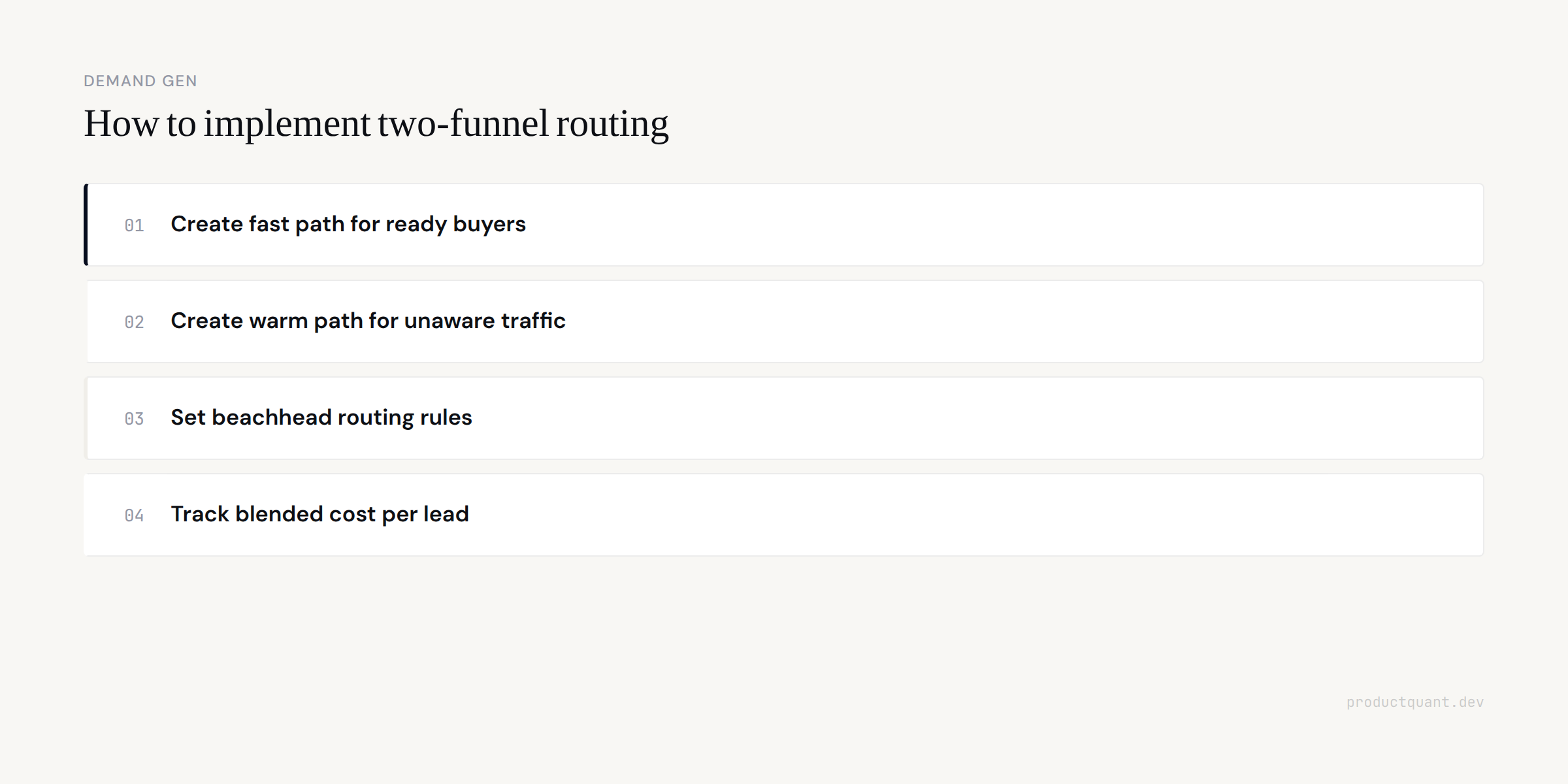
First, map your offers by friction. Stackmatix ranks them clearly: content download, webinar, demo request. Content offers go to the warm path. Demo requests go to the fast path.
Second, score the warm path. YellowInk used dynamic scoring and lifecycle tracks. Only threshold crossing leads move to sales. Without that gate, your sales team drowns in unready leads and the fast path gets starved.
Third, set routing rules from source and behavior. Hot search and retargeting go fast. Cold social and display go warm. Intent signals override the source and pull a visitor into the fast path. Digital Applied's data shows why: intent sourced leads are more likely to close and carry higher deal values.
Fourth, measure blended cost per demo qualified lead, not raw CPL. That is the number that tells you if the two funnel system is working. If the fast path is producing demos at a reasonable blended cost and the warm path is feeding it, you are done.
Sources
- Rob Palmer on Eugene Schwartz's Breakthrough Advertising - Rob Palmer on Eugene Schwartz's Breakthrough Advertising
- LinkedIn B2B Institute: The 95-5 Rule - LinkedIn B2B Institute: The 95-5 Rule
- Stackmatix: LinkedIn Ads Cost Per Lead Benchmarks - Stackmatix: LinkedIn Ads Cost Per Lead Benchmarks
- 42 Agency: B2B Demand Generation Benchmarks 2026 - 42 Agency: B2B Demand Generation Benchmarks 2026
- Digital Applied: Lead Generation Statistics 2026 - Digital Applied: Lead Generation Statistics 2026
- The B2B Playbook: The Simple 3 Step Demand Generation Strategy - The B2B Playbook: The Simple 3 Step Demand Generation Strategy
- Cirrus Insight: Lead Generation Statistics & Trends 2025 - Cirrus Insight: Lead Generation Statistics & Trends 2025
- Revnew: The 95/5 Rule Explained - Revnew: The 95/5 Rule Explained
- YellowInk: Pardot Lead Nurture Case Study - YellowInk: Pardot Lead Nurture Case Study
- Gartner: 61% of B2B Buyers Prefer Rep-Free Buying - Gartner: 61% of B2B Buyers Prefer Rep-Free Buying
- Reach Marketing: Cold Email vs. Warm Lead Nurturing - Reach Marketing: Cold Email vs. Warm Lead Nurturing

About the Author
Jake McMahon is the founder of ProductQuant, a product strategy consultancy and platform for B2B SaaS teams. He builds the DNA Stack frameworks (Product, Market, GTM, Brand Persona) and runs pipeline systems for growth-stage companies.
Related Reading
Route Your Traffic on Purpose
Bring your funnel data. We will map where the ready buyers are and where the warm path leaks.