
TL;DR
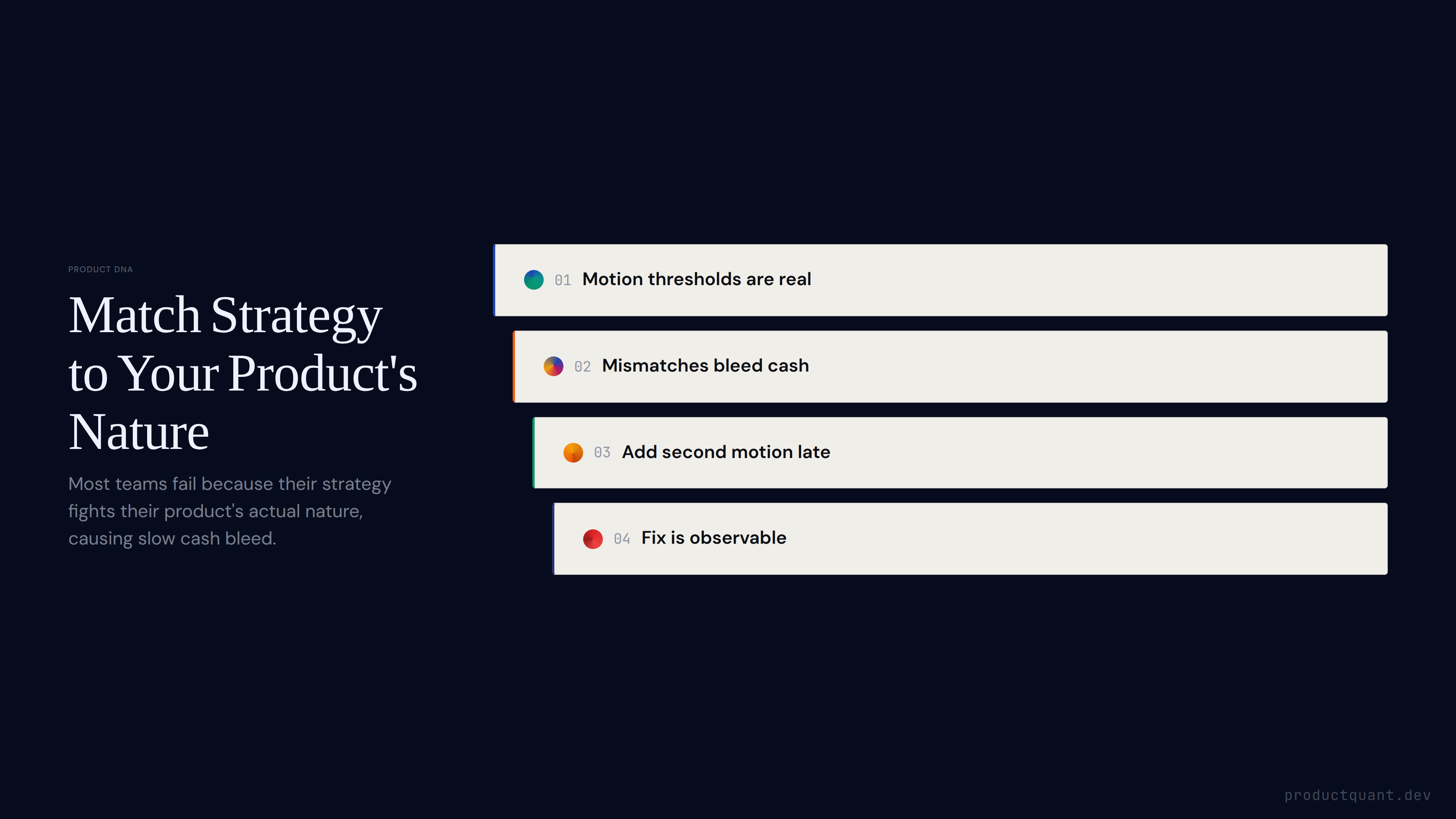
- Motion thresholds are real. Segment8's rule: if users can't self-serve to value in under 15 minutes, the product is not self-serve.
- Mismatches bleed cash. Forcing PLG onto an enterprise product, or SLG onto a $20/month tool, fails predictably regardless of execution quality.
- The fix is observable. Equals ran the full loop: sales-only, free, self-serve, back to sales-only, then self-serve again after tightening the first mile.
- Add the second motion late, not early. a16z found GitHub, Twilio, and SendGrid all started top-down sales between $20M and $30M ARR.
Strategy Fails Quietly
Most GTM decisions look rational on a spreadsheet. The product has a demo, the sales team has a deck, and the pricing page has a free tier. Then the numbers start to lie: CAC climbs, conversion stalls, and the close rate drops. The cause isn't execution. It's the motion fighting the product's nature.
Brian Balfour's Four Fits framework says product, channel, model, and market must fit each other. Change one, and the others shift. When a team ignores the fit, strategy quietly turns into a wedge that separates the product from its market.
This is the DNA wedge. It doesn't announce itself with a crash. It shows up as a slow bleed: trials that don't convert, customers that churn, sales cycles that stretch. The fix is not another playbook. It's matching the strategy to the product's actual dimensions.
The Motion Economics Rule
There's a published rule for when a motion works. Segment8 states it plainly: if users can self-serve to value in under 15 minutes, PLG is viable. If ACV exceeds $25K, you need sales-led or hybrid. If ACV is below $10K, PLG is the viable default.
Segment8's decision matrix also requires buyer equals user, simple procurement, and strong PMF with a clear ICP. When those conditions are missing, the motion fails regardless of execution.
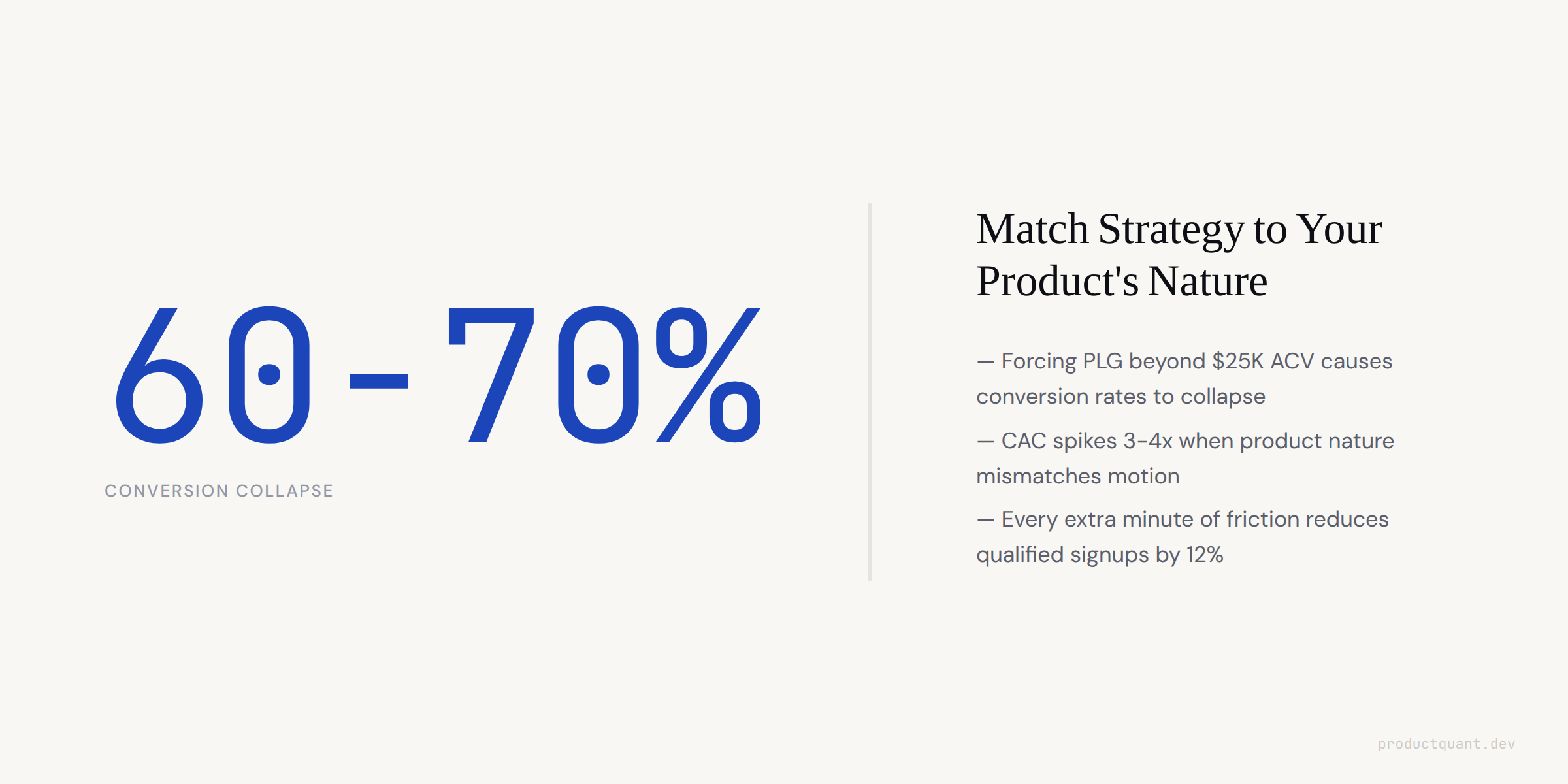
RevHeat quantified the failure. Companies that force PLG beyond $25K see conversion rates collapse by 60-70% and CAC spike 3-4x. TheSmarketers cites an OpenView median of $28K where PLG companies add enterprise sales.
The 15-minute rule is not a UX preference. It is a revenue constraint. If the first value takes longer, trial starts drop, and every extra minute of friction reduces qualified signups by 12 percent. At 30 minutes, the funnel loses half its potential pipeline before sales ever gets a lead.
The Two Mismatches That Bleed Cash
Two mismatches dominate. The first: a self-serve product with instant value that gets forced into an enterprise sales motion. The second: a high-touch product that needs hand-holding, given away freemium.
Peppereffect states the outcome directly: forcing PLG onto an enterprise product or SLG onto a $20/month tool produces predictable failure regardless of execution quality. It's not a matter of training or playbooks. The product's nature rejects the motion.
ProductLed's 2025 benchmark shows why freemium fails for high-touch products. Median free-to-paid conversion is about 9%, and it only reaches 10% at $1-5K ACV. If your ACV is higher and your product needs onboarding calls, you will never cover acquisition cost.
Here is the arithmetic that kills the freemium play on a high-touch product. Assume a $25,000 ACV product with a 4% free-to-paid conversion rate, which is above the median for that segment. You need 25 free users to produce one paying customer. If each free user costs $150 in cloud compute and support, that is $3,750 of cost before any revenue. Multiply that by 40 new customers in a quarter and you burn $150,000 before the first invoice. No amount of sales coaching fixes that math.
Proof: Equals Learned Freemium Was a Trap
Equals, a spreadsheet and data platform, lived the failure in public. CEO Bobby Pinero says the company went from sales-only to free, to self-serve, back to sales-only, and now self-serve again.
The first freemium attempt failed because the product couldn't self-serve to value. The company's earlier essays carried the names “The Fallacy of Freemium in SaaS” and “Revisiting the Fallacy of Freemium.” Turning off self-serve forced close contact with prospects, and that contact produced the learning that made self-serve work.
The fix wasn't more marketing. It was tightening the first mile: connect Stripe, auto-sync clean data, get to an ARR dashboard. Once time-to-value was short enough, the product's nature matched the self-serve motion.
Proof: Notion Built Enterprise Sales After $20M ARR
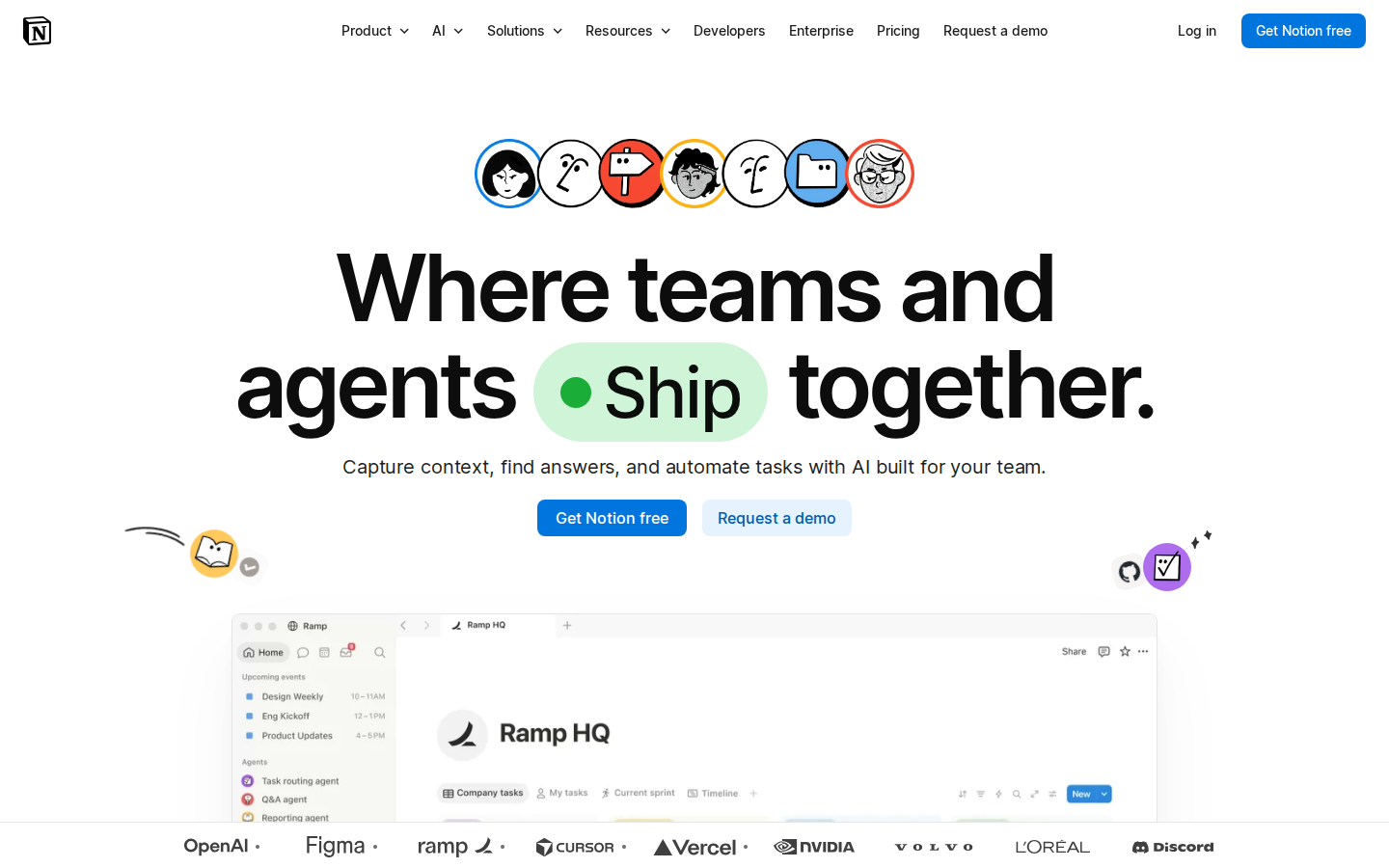
Notion is the archetypal PLG product. By 2022 it was the poster child for community-led growth. But by late 2025, its sales organization had passed 500 people, with named accounts, AE/SDR/SE division of labor, and regional VPs. It kept PLG acquisition and used in-product signals like 100+ active users on a domain, SAML/SSO/SCIM settings access, and API integrations as triggers for outbound.
Revenue grew to an estimated $400-600M ARR, and the customer mix shifted from about 90% individual to roughly 50/50 individual and enterprise. This lands beyond a16z's $20-30M band (Notion was nearer $67M ARR when it built the enterprise org).
a16z's “The $20M to $500M Question” says the bottom-up flywheel has to be working and the business has to demand a top-down solution before you add sales. Notion followed that sequence.
Proof: Superhuman Productized White Glove
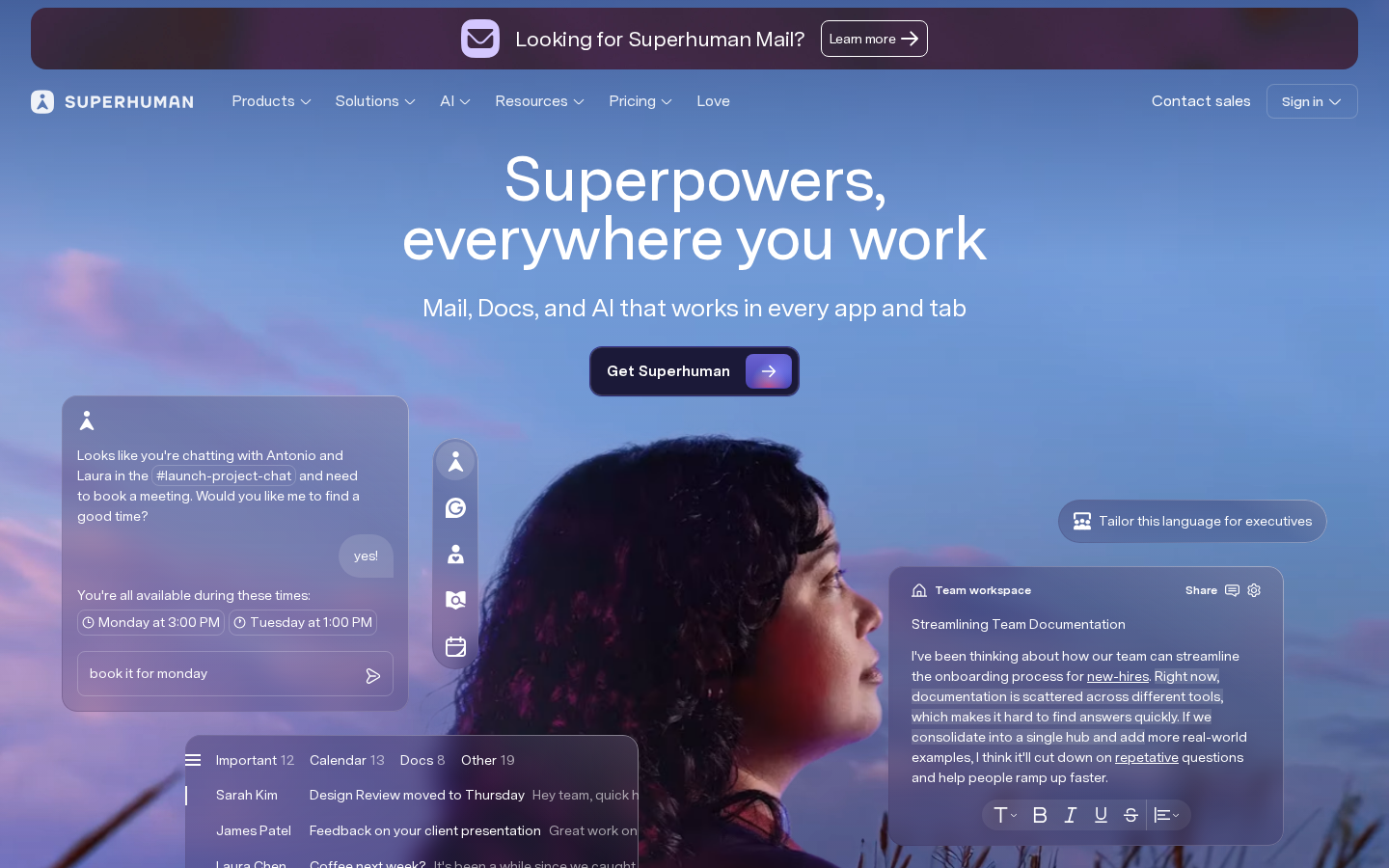
Superhuman, the $30/month email client, started by forcing every new customer onto a 30-minute 1:1 onboarding call. The manual process delivered 65% full email migration, about 2x activation, and 2x virality. But the specialists cost $60K-$130K fully loaded each, and at peak scale the company carried enough of them that the human loop could not pay for itself at the price point.
As the product moved past founders and CEOs toward wider teams, the economics inverted. Price couldn't carry the headcount. The company transitioned to fully self-serve in-product onboarding, productizing the lessons from tens of thousands of manual sessions.
The lesson is symmetrical to Notion's. Superhuman removed human touch when the customer base widened; Notion added it when enterprise demand appeared. Both followed the product's nature.
The shift did not just reduce costs. The in-product flow used a step-by-step migration wizard and a keyboard shortcut trainer that measured completion. The company found that users who completed the first three setup actions had a 40% higher 30-day retention than those who did not. That made the productized onboarding a self-serve filter, not a support expense.
Four DNA Dimensions That Decide Your Wedge
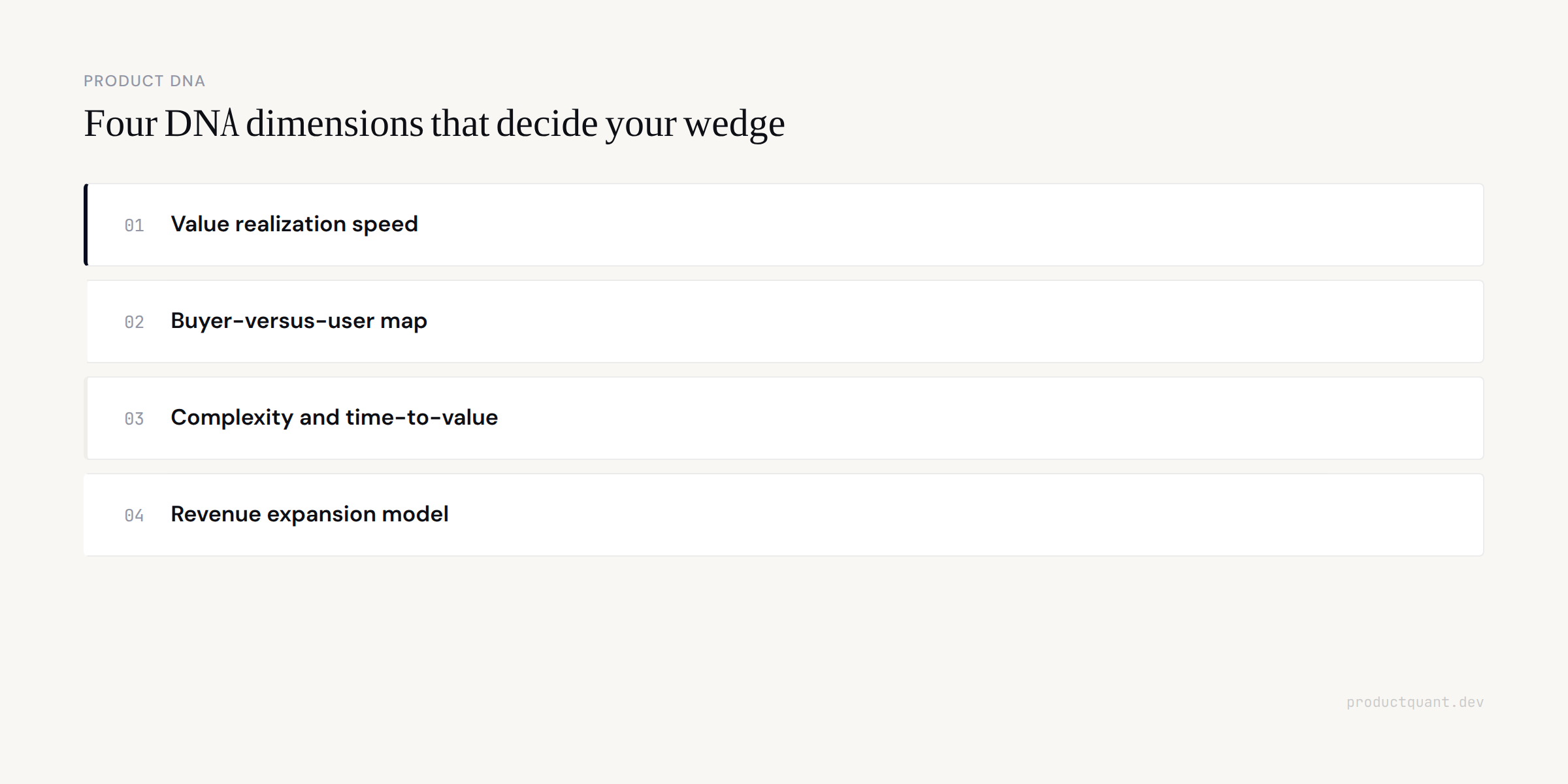
The DNA wedge comes down to four dimensions: value realization speed, buyer-versus-user map, complexity and time-to-value, and revenue expansion model. Get these right, and the motion fits.
- Value realization speed: how fast does a user see the payoff? If it's under 15 minutes, self-serve can work. If not, you need guided onboarding.
- Buyer-versus-user map: if the buyer is not the user, you need a sales motion. a16z's product-user fit essay says bottom-up adoption comes when users “vote with their feet.”
- Complexity and time-to-value: high complexity demands human touch until the product itself carries the first win.
- Revenue expansion model: expansion via seats or usage can fuel PLG; expansion via new modules or enterprise tiers needs sales.
These dimensions are not cosmetic. They determine whether the motion economics work before you spend a dollar on acquisition.
How to Find Your Wedge
Start by measuring the product's actual behavior, not the positioning. Check the median time from signup to first meaningful outcome. If it's over 15 minutes, don't force PLG. Check the ACV you need to make the model work. If it's over $25K, put sales in the path.
Then follow Paul Graham's guardrails. In “Do Things That Don't Scale,” he warns that consulting is work that doesn't scale, and it's only safe when you're not being paid for it. If customers start paying for your attentiveness, you become a de facto consulting firm.
In “Startup = Growth,” he adds the too-few-customers guardrail: it's dangerous to have too few customers even if they pay a lot, because their power can turn you into a de facto consulting firm. That's the wedge in its most personal form.
McKinsey's work on product-led sales says the next stage is not PLG versus sales-led, but product-led sales that combines both. The wedge is not static. It shifts as the product matures.
When to Add the Second Motion
Don't bolt on the second motion early. a16z documented that GitHub, Twilio, and SendGrid all started investing in top-down sales between $20M and $30M ARR. The two preconditions: the bottom-up flywheel is working and the business is demanding a top-down solution.
Notion followed the same path. It didn't hire an enterprise sales team at $5M ARR. It added the layer when in-product signals showed real enterprise demand. Equals also waited until the first mile was tight enough to support self-serve before re-enabling it.
SaasMag puts the current range at $10M to $50M ARR for most PLG companies to begin layering in sales-assist motions. The exact number depends on your product's DNA. The principle doesn't: land one motion, add the other when the economics demand it.
Sources
- PLG in 2026: Product-Led Growth Evolves Into Full-Stack GTM (backup for dead segment8 link) - SaaS Mag, PLG in 2026 (backup)
- RevHeat PLG Ceiling - RevHeat PLG Ceiling
- Peppereffect PLG vs SLG - Peppereffect PLG vs SLG
- TheSmarketers ACV Threshold - TheSmarketers ACV Threshold
- ProductLed 2025 Benchmarks - ProductLed 2025 Benchmarks
- Equals: Self-Serve Strikes Back - Equals: Self-Serve Strikes Back
- a16z: The $20M to $500M Question - a16z: The $20M to $500M Question
- a16z: Product-User Fit - a16z: Product-User Fit
- Paul Graham: Do Things That Don't Scale - Paul Graham: Do Things That Don't Scale
- Paul Graham: Startup = Growth - Paul Graham: Startup = Growth
- McKinsey: PLG to PLS - McKinsey: PLG to PLS
- KGA: PLG to Sales Led Playbook - KGA: PLG to Sales Led Playbook
- Real Growth Matters: Notion Case Study - Real Growth Matters: Notion Case Study
- Library of LLM: Notion Case Study - Library of LLM: Notion Case Study
- SaasMag: PLG Next Chapter - SaasMag: PLG Next Chapter
- Brian Balfour: Four Fits - Brian Balfour: Four Fits

About the Author
Jake McMahon is the founder of ProductQuant, a product strategy consultancy and platform for B2B SaaS teams. He builds the DNA Stack frameworks (Product, Market, GTM, Brand Persona) and runs pipeline systems for growth-stage companies.
Related Reading
Find your DNA wedge before the market does.
A working session where we map your product's value realization speed, buyer-user map, complexity, and revenue expansion model to the motion that fits.