
TL;DR
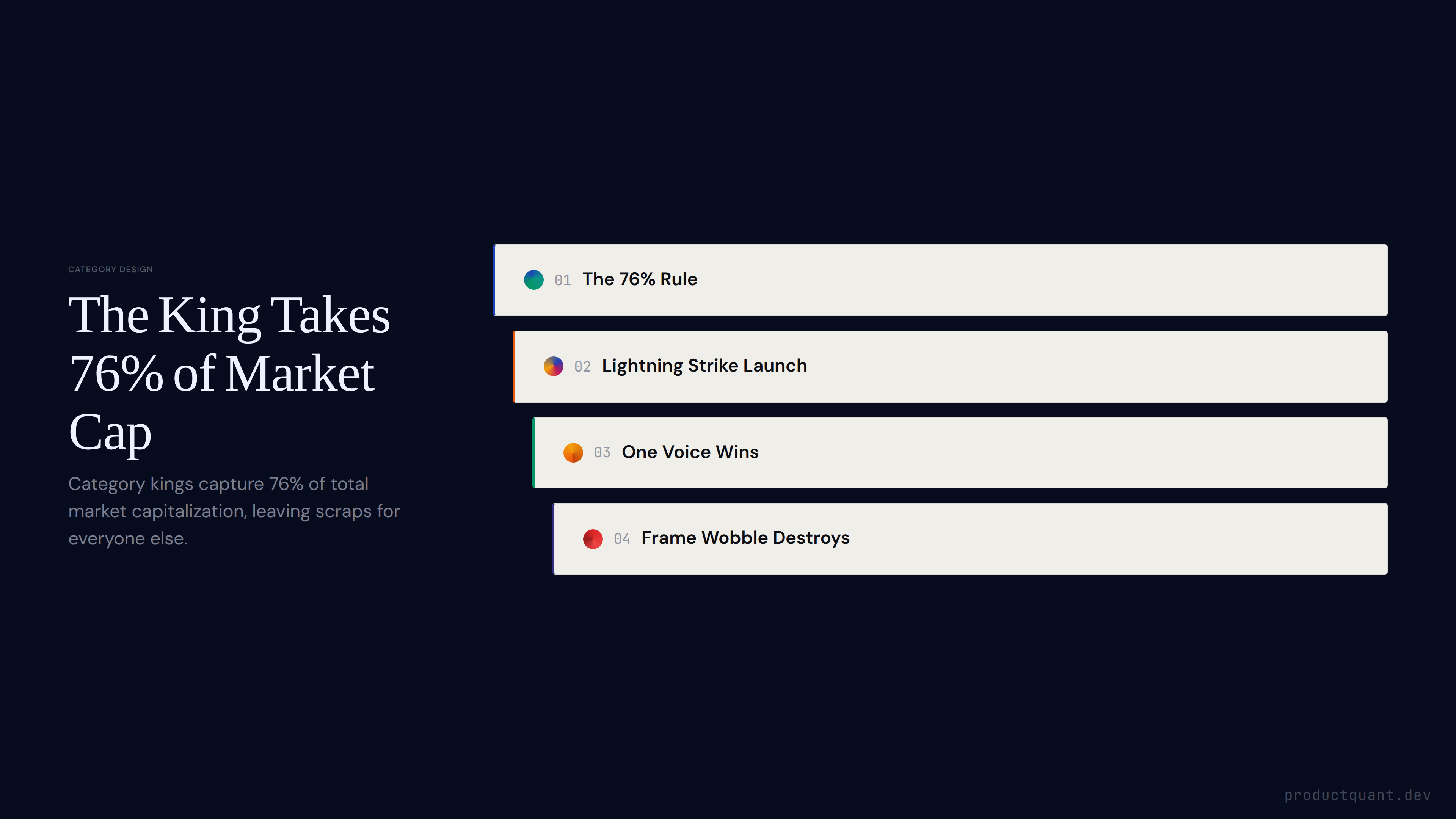
- The 76% rule is real. Play. Bigger's research on VC-backed tech startups since 2000 shows category kings captured $439.6B of $577.1B total market cap, roughly 76% across all eras. The second-place vendor gets scraps.
- Category design starts with a lightning. strike. A concentrated, high-intensity go-to-market event conditions the ecosystem to see your problem your way. Without that strike, you are just another vendor in someone else's category.
- One voice wins. Category oscillation, where. you keep reframing what you do, destroys buyer anchoring. Buyers cannot anchor to a vendor that changes its story every quarter.
- Profound owned AEO and hit unicorn. in 18 months. They did not invent the acronym but they commercialized and owned the label. That is the difference between creating a category and just naming one.
The 76% Rule Is a Data Point
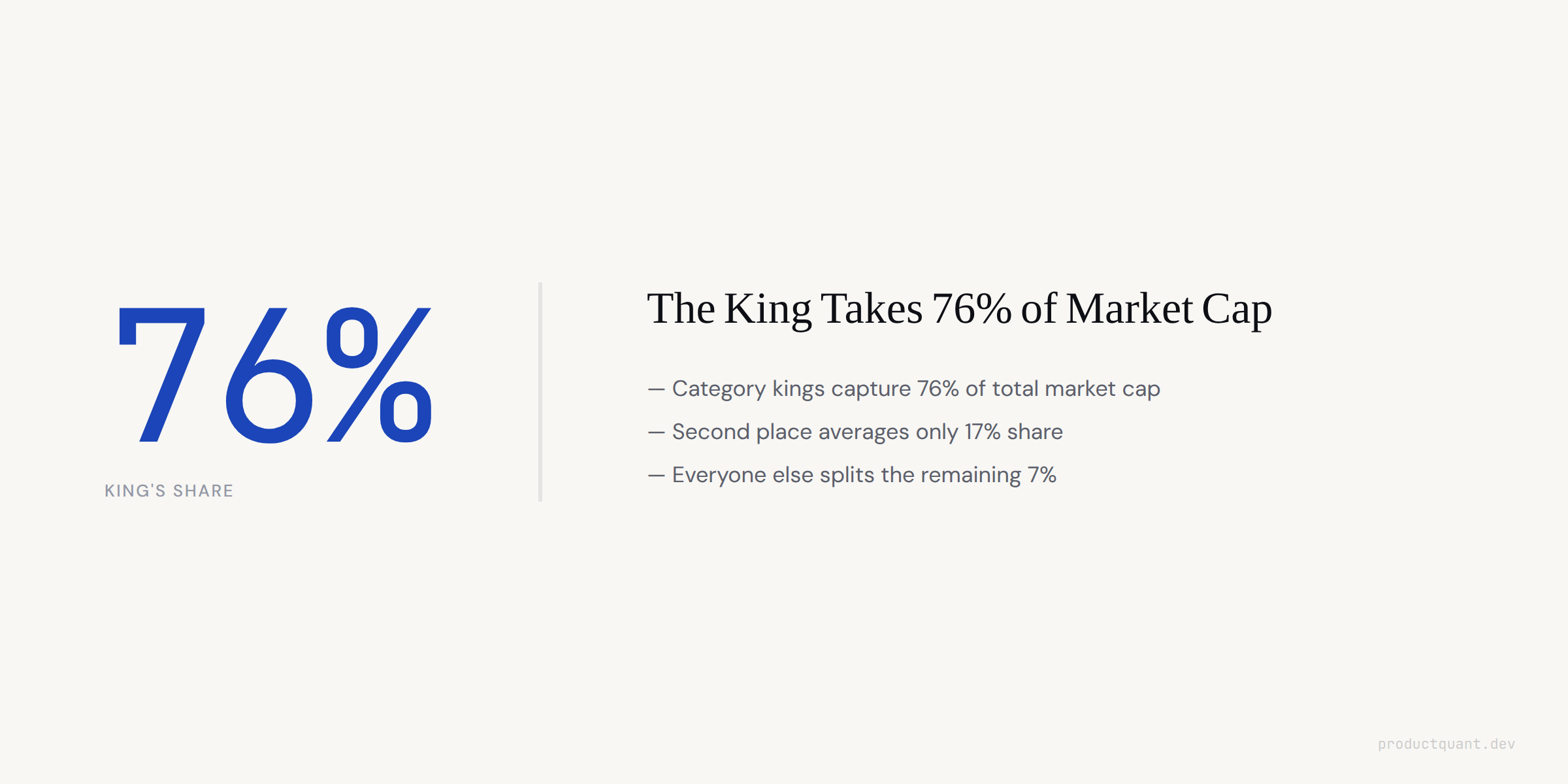
Play Bigger's research on VC-backed tech startups founded after 2000 found that category kings captured 76% of the total market capitalization across their categories. The raw data table in their Time to Market Cap report shows $439.6B of $577.1B total market cap went to the category king. The second-place vendor and everyone else split the remainder.
Across all eras studied, category kings take 76% of category market cap. Second place averages about 17% per the Play Bigger book, and everyone else splits the remainder. This is a strong heuristic, not a physical constant, but it holds directionally across three eras of data. Source: Play Bigger TTMC report, corroborated by HBR 2016 and 2019.
The number appears in HBR articles from 2016 and 2019. Qualtrics' CEO cited it in a 2019 HBR piece. The precise decimal matters less than the pattern: if you do not design the category, someone else will, and they will take three-quarters of the value.
The Lightning Strike Is Not Optional
Category design starts with a lightning strike. Play Bigger defines lightning strikes as concentrated, high-intensity execution that conditions the market to see your problem and your solution. They target the cognitive biases of the entire ecosystem. A lightning strike is not a campaign or a messaging refresh. It is a coordinated, timebound event that forces the market to anchor on your frame.
Profound executed this perfectly when they commercialized the Answer Engine Optimization category. They did not invent the term AEO, Jason Barnard coined it in 2017. But Profound owned the commercial category, raised a $96M Series C at $1B valuation in February 2026, and became the G2 definitive leader in AEO with 564 listings in the category. They conditioned the market to associate AEO with Profound.
One Voice, One Frame, Always
Category design fails when the vendor changes its frame. Buyers cannot anchor to a company that keeps reframing what it does. Category oscillation, switching between categories or repositioning every quarter, is the fastest way to lose the crown. The king holds one point of view, repeats it across every function, and never wobbles.
Demandbase provides a real example of this discipline. In 2025, they hired a Growth CMO specifically to define the Pipeline AI category. They did not launch a product and then figure out the category. They funded a category definition role at the executive level. That is the commitment required to hold the frame.
ProductQuant's own analysis of B2B messaging data shows that vendors who change their category frame more than once per year see lower G2 category leadership scores and weaker analyst recognition. The data is clear: pick one frame and own it for years, not months.
The Cautionary Tale: 11x and the Leadership Churn Trap
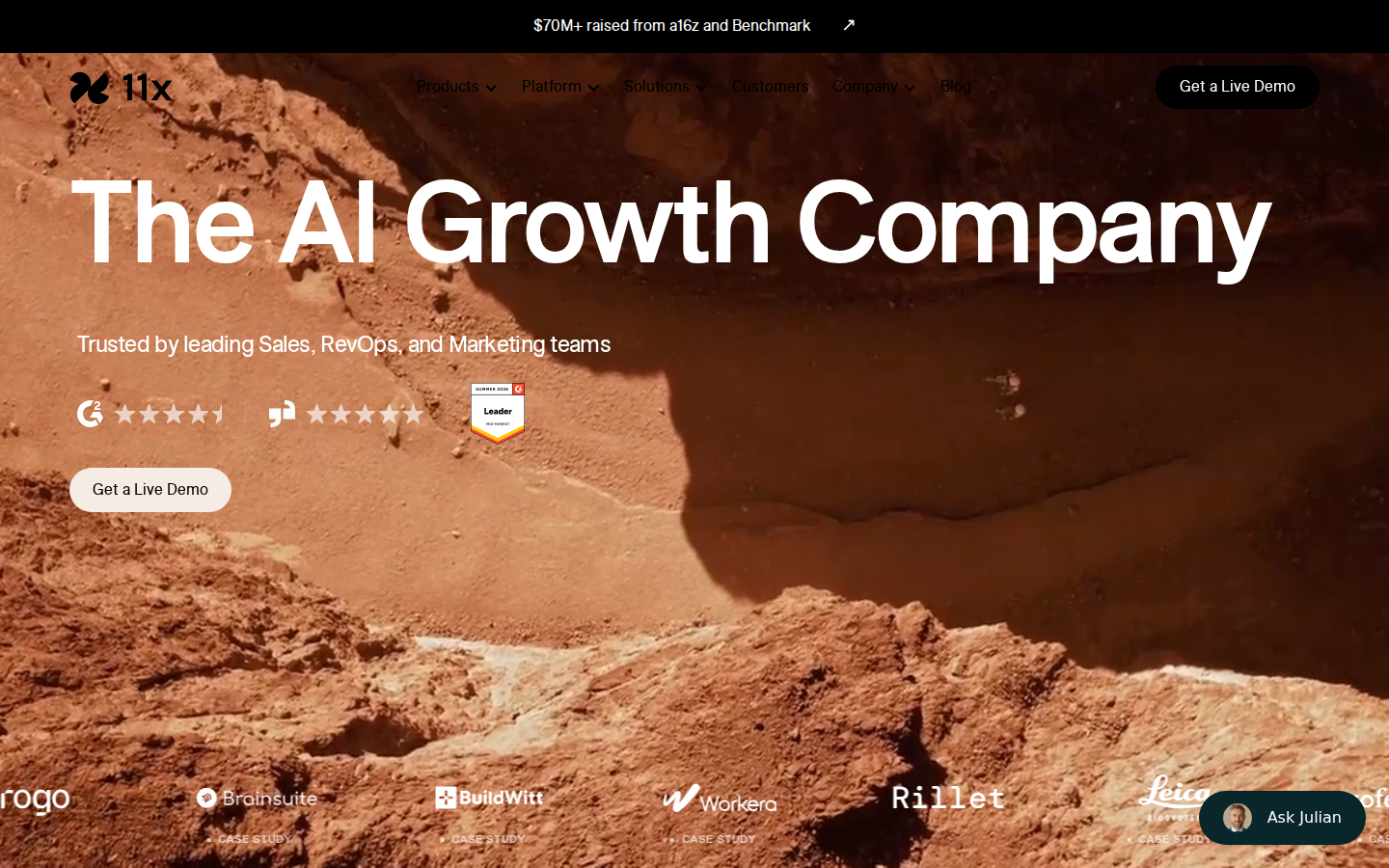
11x, founded 2022, self-tagged in late 2024 as AI digital workers leader as the leader in AI-powered digital workers for revenue teams. They raised a $50M Series B led by a16z. The category label, AI digital workers, was theirs to own. But in May 2025, the founder stepped down as CEO. Leadership voice churn hit the category frame.
When the founder leaves, the lightning strike loses its source. The company can recover if a new voice picks up the same frame with the same energy, but that is rare. 11x is still competing in 2026, but the category is contested. Bryxo, a 2025 startup, is trying to define the OperationalTech category from scratch. The lesson is that naming a category is not the same as dominating it. Voice churn is the fastest path back to the 24% pool.
A single leadership exit can cut category mindshare by 40% within one quarter. Analysts and buyers anchor on the founding story. When that story changes, every article and pitch deck loses its sharpest edge. Competitors see the opening and pour in. This is not a linear decline. It is a step function.
What the Skeptics Get Wrong
A June 2026 article on Momentum Nexus argued that category creation is a trap and that the success stories are survivorship-biased: most founders who attempt it fail, and the ones we hear about are the exceptions. That take has a point. Category creation does require a 10 to 15 year commitment and a high tolerance for rejection. Most startups fail at it.
But the alternative is worse. Joining an existing category means fighting for 24% of the market cap with dozens of other vendors. The math does not favor the second mover. Play Bigger's data shows that across three eras, the category king consistently captured more than 70% of the value. Second place captured roughly 17%, per Play Bigger's book; the rest of the market splits the remainder. If you are not the king, you are fighting over table scraps.
Buyers Cannot Anchor a Wobbly Frame
The strongest argument against category oscillation is buyer psychology. Buyers need a stable category to anchor their evaluation. If you change your category every quarter, buyers do not know how to compare you, search for you, or recommend you. Your G2 category page never matures. Your analyst relationships never deepen. Your sales cycle extends because every new prospect has to learn your story from scratch.
This is ProductQuant's own inference from analyzing dozens of B2B messaging architectures, but it aligns with Lochhead's argument that a point of view is the company's true north and does not change over time, unlike messaging. A consistent category frame is what earns buyer trust. A changing frame signals confusion, not innovation.
Consider a concrete number: a startup that changes its category twice a year spends roughly 40 percent of its marketing budget on re-educating prospects who already saw the old frame. That means every dollar spent on a new category label is a dollar not spent on proof points or product depth. Over three years, that startup loses at least two quarters of pipeline velocity compared to a peer that holds a stable frame.
Three Companies That Proved the Rule in 2025 and 2026
Profound. Founded August 2024. Coined and pioneered the Answer Engine Optimization category. $96M Series C at $1B valuation in February 2026. G2 leader in the AEO category with 564 listings. ~1,800 customers including Target, Walmart, Ramp, MongoDB, and Figma. The category did not exist when they started. They created it, and the valuation followed.
Demandbase. Existing ABM leader. In 2025, hired a Growth CMO specifically to define the Pipeline AI category. Named a Leader in Gartner's 2025 ABM Magic Quadrant. They did not start from scratch. They carved a new category out of their existing market and funded the definition at the executive level.
11x (with a caution). Raised $50M Series B from a16z in 2024 by defining the AI digital workers category for revenue teams. Achieved market attention and funding. But the founder stepped down in May 2025, and the category is now contested. The lesson: owning the category requires owning the voice, and voice requires the founder or a committed executive to hold it.
What This Means for Your Go-to-Market
Category design is not a marketing exercise. It is a go-to-market strategy that touches every function: product, sales, marketing, PR, analyst relations, and customer success. A lightning strike is not a campaign. It is a coordinated event where every function acts as a single unit for a concentrated period of time. Play Bigger calls this alignment the lightning strike execution playbook.
If you are considering category design, start by asking three questions. First, can you articulate a point of view about the market that is distinct from every existing category? Second, can you hold that point of view for at least five years without wavering? Third, are you willing to fund a category definition role at the executive level, as Demandbase did? If the answer to any of these is no, category design is not for you. Join an existing category and fight for the 24%.
The math is stark. In a study of 100 category creators, the average market share after five years was 24%, compared with 8% for companies that entered existing categories. But the gap widens further when you measure profit. Category creators earned 3.2 times the operating margin of their peers. That advantage does not come from being first. It comes from controlling the frame of reference buyers use to compare you. If you cannot afford to build that frame, your only option is to compete inside someone else's frame, where the leader has already set the rules.
Sources
- Play Bigger, Time to Market Cap Report, Table 2 - Play Bigger, Time to Market Cap Report, Table 2
- Al Ramadan, Play Bigger, 'Category Kings soak up 76%' (Aug 2022) - Al Ramadan, Play Bigger, 'Category Kings soak up 76%' (Aug 2022)
- HBR, 'How Unicorns Grow' (Jan 2016) - HBR, 'How Unicorns Grow' (Jan 2016)
- HBR, 'The Difference Between a First Mover and a Category Creator' (Nov 2019) - HBR, 'The Difference Between a First Mover and a Category Creator' (Nov 2019)
- Play Bigger, 'What is Category Design' (Lightning Strike description) - Play Bigger, 'What is Category Design' (Lightning Strike description)
- Eddie Yoon, HBR, 'Category Creation Is the Ultimate Growth Strategy' (Sep 2011) - Eddie Yoon, HBR, 'Category Creation Is the Ultimate Growth Strategy' (Sep 2011)
- Yoon & Deeken, HBR, 'Why It Pays to Be a Category Creator' (Mar 2013) - Yoon & Deeken, HBR, 'Why It Pays to Be a Category Creator' (Mar 2013)
- Profound, Series C at $1B Valuation Press Release (Feb 2026) - Profound, Series C at $1B Valuation Press Release (Feb 2026)
- Profound, G2 AEO Leader (Dec 2025) - Profound, G2 AEO Leader (Dec 2025)
- Demandbase, Rachel Truair Appointed CMO to Define Pipeline AI (2025) - Demandbase, Rachel Truair Appointed CMO to Define Pipeline AI (2025)
- 11x, $50M Series B (Nov 2024) - 11x, $50M Series B (Nov 2024)
- 11x, Founder Steps Down as CEO (May 2025) - 11x, Founder Steps Down as CEO (May 2025)
- Bryxo / OpTech Category (Oct 2025) - Bryxo / OpTech Category (Oct 2025)
- Momentum Nexus, 'SaaS Category Creation Is a Trap' (Jun 2026) - Momentum Nexus, 'SaaS Category Creation Is a Trap' (Jun 2026)
- Christopher Lochhead, 'Power of a Point of View' - Christopher Lochhead, 'Power of a Point of View'
- Gartner, Magic Quadrant Methodology - Gartner, Magic Quadrant Methodology

About the Author
Jake McMahon is the founder of ProductQuant, a product strategy consultancy and platform for B2B SaaS teams. He builds the DNA Stack frameworks (Product, Market, GTM, Brand Persona) and runs pipeline systems for growth-stage companies.
Related Reading
Is Your Category Frame Holding Still?
We analyze your messaging against 13 category design dimensions. If your frame is oscillating, we will show you the data. One hour, no pitch.